

Emma adaptations
If you’ve ever tried to find the best adaptations of Emma, you’ll know there’s no single “correct” answer… only different interpretations of the same story.
Because Emma isn’t just about matchmaking and miscommunication. At its core, it’s a redemption story… just not in the way we usually think about them.
There’s no singular turning point. No dramatic fall followed by a neat resolution. Instead, Emma’s arc unfolds slowly, almost quietly, through a series of realisations that are often uncomfortable and rarely immediate. Emma’s flaw isn’t cruelty. It’s certainty.
She believes she understands the people around her. She think that she can guide them, improve their lives, and shape outcomes for the better. And for a long time, nothing in her world challenges that belief. Until it does.
The consequences of her actions aren’t always dramatic, but they are real. They ripple outward, affecting other people in ways she doesn’t fully see until it’s too late to undo them… and the story lets those moments sit.
Her growth, then, isn’t about becoming a different person. It’s about learning to see clearly, both herself and others. That’s what makes Emma so difficult to adapt.
So much of that shift is internal. The movement from certainty to self-awareness. Every adaptation has to decide how visible to make that change, how flawed Emma is allowed to be, and how much the audience is asked to sit with her mistakes.
And that’s where they begin to diverge.
This guide looks at the most popular Emma adaptations, not just in terms of which is “best”, but how each one engages with that underlying arc… and which might work best depending on what you’re looking for.
If you’re interested in that idea of character growth more broadly, I’ve written more about it in my post on redemption arcs.

TL;DR
If you’re trying to decide where to start, it really comes down to what you’re looking for from the story… because each adaptation leans into a different version of Emma.
If you want the most faithful version (and the strongest character arc):
The BBC miniseries Emma (2009) is the closest to the original text. It takes its time, lets Emma be flawed, and actually gives space for that slow shift in self-awareness to land. Noting that it is 4.5 hours long.(Plus, Jonny Lee Miller is the BEST Knightley. A hill I will die on.)
If you want a modern retelling that still understands the core story:
Clueless is surprisingly sharp. It translates Emma’s certainty into a completely different setting, but keeps the structure of her growth intact… which is why it works. In saying all of this, it does show its age (being over 30 now) in the dialogue — and slurs.
If you want something lighter and more accessible:
Emma (1996) is probably the easiest entry point. It softens some of Emma’s harsher edges, but still gives you the basic shape of the story.
If you want something visually beautiful:
Emma. (2020) is stunning to look at… but for me, it prioritises aesthetic over character, which means the emotional arc doesn’t land in quite the same way. And I can’t even with the changes they made to the story iteself.
None of these are doing exactly the same thing, which is part of what makes Emma such an interesting story to revisit. The plot stays recognisable, but the way Emma herself is interpreted can shift quite dramatically depending on what each adaptation chooses to emphasise.
However, if you’re interested in how each version handles Emma’s character arc, and why that matters, keep reading.
Original text
Emma — Jane Austen

There’s a famous line Jane Austen is said to have written before starting Emma:
I am going to take a heroine whom no one but myself will much like.
Now, I don’t say this lightly, but she failed. Because Emma is my favourite of Austen’s characters.
Emma Woodhouse is spoilt, vain, and at times has a bit of a ‘pick me’ streak. But she is also, as Austen tells us, handsome, clever, and rich… and crucially, she has never had a reason to question herself.
Published in 1815, Emma sits in a world where women were expected to marry or risk financial insecurity. The only real exception was wealth. And even then, it was rarely held by women in their own right.
Emma is the exception.
She has money, status, and independence, and because of that, she has no intention of marrying. That alone sets her apart from most Austen heroines — and it’s where her story becomes interesting.
If you know the book, feel free to skip ahead, but I want to briefly outline why the story works so well. Spoilers ahead.
In my Top 5 bookish villains post, I talk about how the best villains act as mirrors. They reflect back to the protagonist who they are, or who they could become. By that logic, I’d argue that Frank Churchill is the villain of Emma.
Frank, Emma, and Jane Fairfax are all the same age, all from Highbury, and all shaped by loss with each having lost their mothers young, and with Jane losing both parents. From there, their lives diverge.
Emma is raised in comfort, by her father, in a loving home. Frank is raised by an aunt he doesn’t love, tied to her through the promise of inheritance. Jane, by contrast, is dependent on the kindness of others, with no wealth of her own and very little security.
They begin in similar circumstances… and end up entirely different.
When they come back together as adults, Emma and Frank appear the most alike. Both privileged, both charming, and both used to being indulged. But where Emma’s flaws come from carelessness, Frank’s feel deliberate, sharper, and more self-aware. And beside them, Jane is quiet, restrained, almost disappearing by comparison, despite her continued comparisons to perfection. (Which in turn irks Emma a great deal.)
As Frank draws Emma further into poor behaviour, no one intervenes. She is too well-liked, too powerful within her small community. It’s difficult to challenge someone with that level of privilege, and even more so in a society structured the way Highbury is.
Except for Knightley.
As Emma’s social equal, he is one of the few people who can call her out… and he does. His rebuke, “It was badly done, indeed!”, lands perfectly because it cuts through Emma’s certainty. It forces her to see herself and what she has become under Frank’s influence.
And that’s the part of the story that often gets lost.
Many adaptations focus on Harriet’s transformation, Elton’s theatrics, or the romance with Knightley (particularly the age gap), but they miss the quieter shift underneath it all. The gradual change in how Emma sees herself, and the consequences of the way she has treated others.
Because Emma isn’t really about matchmaking.
It’s about reckoning with who you are — and choosing to be better.
Emma adaptations (in reverse release order)
Emma. — film (2020)
 In the 2020 film adaptation of Emma, Anya Taylor-Joy portrays our main character. And she definitely brings a different air to Emma than others. This version is not sweet or timid. She’s forthright in her character: entitled, scathing, pompous with almost a celebrity air about her, even petulant at times. But it’s not just the portrayal of Emma that annoys me about this version. It’s the entire film.
Mr Woodhouse (Bill Nighy) is highly energetic in his role. He jumps down staircases, bounds into rooms, and bounces out of his seat. His concerns of getting ill or feeling drafts is ridiculous. Emma makes a comment that alludes to a possible Munchausen Syndrome diagnosis when referencing daily doctor visits. He orders multiple screens to be brought in that physically close him off from others. And when Isabella arrives, they feed off each other and become increasingly comical. This Mr Woodhouse is not beloved, and has superficial relationships with his “friends”. He visibly flinches when Miss Bates speaks with him and outright mocks Mr Elton (who is portrayed like a Mr Collins Jr). You would be forgiven for thinking that Emma’s poor behaviour in this adaptation is a product of her upbringing, rather than Frank Churchill’s influence.
Mr Knightley (Johnny Flynn) is unprecedented. The age gap between he and Emma seems smaller, and his brother looks far older. Although, John also looks deeply unhappy and increasingly stressed by Isabella, so perhaps that accounts for his looks. Mr Knightley is vexed by things Emma says and does throughout the film, not just when we expect him to. He also seems to be the catalyst (or at least an antagonist) for the rivalry between Emma and Jane Fairfax. During the piano scene he outright says to Emma that she wishes she was as accomplished as Jane. While this adaptation does show Mr Knightley has feelings for Emma, it also shows him throwing tantrums. At one point he stomps into a room, rips off his clothes, and then throws himself on the ground, kicking. He barely behaves better than Emma, so how could he possibly be expected to guide her.
Harriet (Mia Goth) seems to sway between being terrified of Emma and annoying her. And Emma treats her with a hot/cold relationship. Emma often looks at Harriet with disdain, such as when she arrives to tell Harriet about Mr Elton, Harriet has flour all over her face. (Could be a nod to egg on her face?). The scene when Harriet sleeps over and they practice dancing is lovely though. It shows that when Emma wants to, they could be true companions despite the social hierarchy difference. Although the rest of their relationship is populated with Emma closing her eyes in annoyance and sighing. At one point Emma throws Harriet’s journal out of the carriage into water.
There are four things this adaptation of Emma does different from the others. Firstly, it has scenes that Emma isn’t in. In particular, a meeting between Mr Knightley and Mrs Weston where they discuss Emma. Second, the other girls from Mrs Goddard’s are constantly paraded around Highbury. Almost like the cast of Madeline, in their matching cloaks in two straight lines. Third, the visibility of the servants is distracting. They’re obviously placed in many scenes to draw the eye. Although none of them say anything (a case of seen but not heard) — almost as chariatures of their status. This includes Robert Martin (so well played by Connor Swindells) who has no speaking lines at all, yet manages to portray his every emotion beautifully.
Finally, the ending. And I don’t just mean the nosebleed that hurt my soul. (Why? Why was this necessary?) At no point in the original or any other retelling or adaptation, does Emma reject Mr Knightley’s proposal because she fears hurting Harriet. In fact, it seems even more ridiculous in this because Emma has treated Harriet the worst in this. But to also go from the rejection (she does say yes in the end, obvs) to voluntarily asking Robert Martin to propose again to Harriet, and then when Harriet identifies her father to inviting them to Hartfield is just plain weird. Especially since in the book (the only other time Harriet’s father is identified) Emma pushes the friendship away due to her father being so far below Emma in societal hierarchy.
Emma — BBC miniseries (2009)
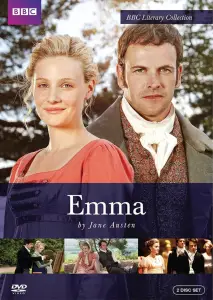 Ahh, I could write an entire essay on this adaptation and how much I love it. But I won’t subject you to that. I will say that I think the casting was fantastic, and the portrayal of the characters true to the novel. Because it is a BBC miniseries adaptation, it is almost word for word correct for the novel, with really only the relationship with Harriet softened in this version compared to the book. But this seems to be a feature of every adaptation in existence.
Emma (Romola Garai) is the sweetest portrayal of the Emma’s in any of the adaptations I’ve seen. And I think I’m only missing the 1996 TV film with Kate Beckinsale. In this adaptation, Emma is clever, pretty, jealous, a bit snobbish, but also wistful for what she hasn’t had. There’s an entire element of her personality that isn’t explored anywhere else, as Emma has never left Highbury. This adaptation also explores the difference between being bookish smart and worldly smart, and how Emma, despite being clever, is also naïve.
Mr Knightley (Jonny Lee Miller) is my favourite Knightley. He’s the most patient with Emma, and is a good influence on her behaviour all of the time. He encourages her as well as admonishes her. And he shows her how to be empathetic with those of lower social hierarchy while still maintaining his. His frustrations are tempered by his love for her and his want for her to be better. Even in the scene at the Box Hill picnic he doesn’t belittle her, but rather is disappointed in her actions. And while he does raise his voice, he starts and ends the scene softly.
Jane Fairfax (Laura Pyper) plays Jane in a way that entreats you to her. And despite their set up as rivals, even Emma starts to like Jane by the time Mr Knightley has the party to Donwell Abbey. In this adaptation, I think I think it’s the hardest to see a relationship between Jane and Frank Churchill. But whether that’s intentional or the actors don’t have chemistry, I’m not sure. When they are in scenes together, Frank is resolutely not paying attention to Jane, which works to the greater storyline of their engagement being secret. It also makes the scenes at Donwell Abbey between Emma and Jane, and then Emma and Frank so much more interesting.
Emma — film (1996)
 Surprisingly, much like the 2020 adaptation of Emma, Gwyneth Paltrow’s version of the character is arrogant, petulant and snarky at times. She often looks annoyed when people speak to her and is dismissive of everyone around her. Mr Knightley (Jeremy Northam) is tantrum-throwing childish and gossipy at time, which begs the questions why, when he is supposed to be the more mature of the two.
However, this Emma does make amends. There is a kindness to her that is portrayed when she visits the Clarks, where she cares for the family — bringing them food and warming them with blankets. And genuine regret and sadness for Harriet when she visits Mrs Weston following her rejection of Mr Elton. It’s scenes like this that temper the vapidness of the character and show that she does care for those around her, despite being spoilt.
One thing that really vexes me about this adaptation is the portrayal of Jane Fairfax (Polly Walker). Jane is supposed to be Emma’s alternate: sweet, shy, timid and quietly accomplished. This Jane is snobbish, arrogant and quick to smile (or smirk). It puts their comparison in an odd position because they both behave badly, although Jane has no reason to, being poor and an orphan.
This adaptation really shows the flirtatiousness between Emma and Frank (Ewan McGregor) and the expectations of those around them to be together. Mr and Mrs Weston’s desire to see Emma and Frank together really comes across when they tell Emma he is engaged. When Emma is horrid to Miss Bates, it doesn’t come across as Frank’s influence, but rather a product of her own selfishness and disregard for others.
Finally, I though the fourth wall break at the end of the film was an interesting choice. Especially since this adaptation was narrated (I think by Greta Scacchi, although I can’t confirm this anywhere).
Clueless — film (1995)
 While not a traditional adaptation of Emma, Clueless is a modern retelling, but I have included it anyway. Mostly because I have thoughts. Thankfully, I can watch Clueless as a piece of 1990’s film history and enjoy it for what it is. But when compared to Emma, I definitely don’t enjoy it as much.
Our Emma in this is Cher, portrayed by Alicia Silverstone. Cher is a vapid, spoilt, rich, vain, 16 year old, attending a Los Angeles high school. Think of an underage Paris Hilton from the 2000’s. Cher is interested in makeovers and making up excuses to her teachers to increase her grades, rather than doing actual work. The exception to this is when she is made Captain of the Pismo Beach Disaster — this adaptations helping the poor scene. There is one scene when Cher actually proves that she isn’t a total dumb blonde, when she corrects Josh’s date on the Hamlet/Polonius quote.
In this adaptation, it’s very clear that Cher is crushing on Christian — the Frank Churchill character — when he arrives. She thinks they are dating, and when she tries to lure him to sex, he rebuffs her and is later told he is gay. The Jane Fairfax character is ultimately Christian’s sexuality.
The Harriet character, Ty, starts off sweet and meek, although she does allude to having sex and taking drugs. As she becomes more popular, Ty loses her kindness, becomes more superficial and starts belittling Cher. At the start Ty shows some of her artwork to Travis (Robert Martin equivalent), but then nothing is mentioned on this for the rest of the movie.
Because Cher is 16, her father plays a bigger role in this than other adaptations. Where Mr Woodhouse is normally concerned with his and others health, Cher takes on the role of looking after her father, dictating what he can and can’t eat, and booking him appointments.
Now I haven’t spoken about the age gap between Emma and Mr Knightley is this entire post. And that’s because I really see it as a product of its time, and it doesn’t bother me. Yes, even though it’s 16 years difference. Also, Emma is 21 and doesn’t need to marry so I don’t find it an issue. But it bothers me in Clueless. See, in Clueless, Josh (played by Paul Rudd) is our Mr Knightley, and he is 21. Which makes him 5 years older than 16 year old Cher. Cher mentions that their parents were married and broke up five years before, so we know Cher was 11 and Josh was 16, at the most, when they lived together as step-siblings.
Given that Cher’s dad is mentoring Josh and letting him live there, you assume they must have spent some decent time married, or that Josh never really left after the parents break up. Cher’s dad says at one point that you divorce spouses, not children. Now, I know that step-siblings, or ex-step-siblings is a whole trope in romances. But we can probably safely say that Josh was living with child Cher when he was going through puberty. And is now dating underage Cher when he can legally drink. Honestly, kind of icky. I think if Cher were 18 in this adaptation, I would have far less of an issue with the age difference.
Do you have a favourite Emma adaptation?

meeghan
Hi!! I'm Meeghan 😊 I like books (surprise). I also like games (board, video and D&D), baking (mostly cakes) and travel. I live in Canberra, Australia with Husband and 3 black rescue kitties.


You May Also Like

The Love Hypothesis book vs movie

Let’s Talk Bookish: Why I read Middle Grade books